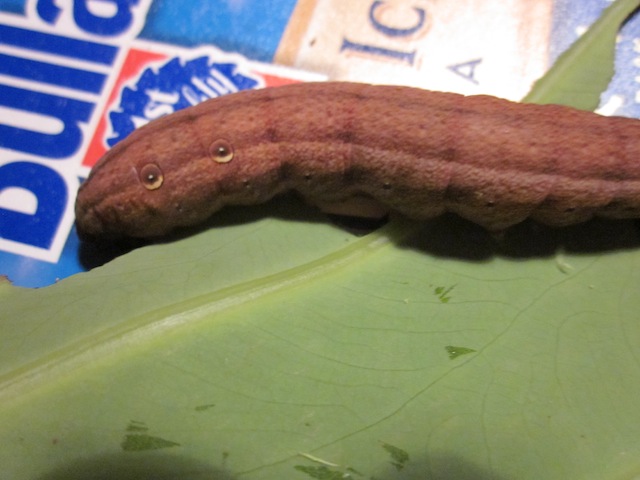
This afternoon after bringing some silverbeet leaves in for our dinner we found several of these:
It is called a Striped Ladybird - binomial name is : Micraspis frenata
According to the link below they are a "good" ladybird - ie eat other insects
-the larvae of this species eats aphids
http://www.ozanimals.com/Insect/Striped-Ladybird/Micraspis/frenata.html
The silverbeet leaves are being eaten by some insect - probably grasshopppers
and there are no aphids around that I have spotted, so I have no explanation as to
why they are on the silverbeet.
Monday, April 16, 2012
Thursday, April 12, 2012
Transverse Moth
Checking the Rosella this afternoon we noticed that the three in the vegetable garden that have yet to flower - they were purchased from Bunnings - are being decimated by caterpillars.
The caterpillars are quite striking as indeed is the adult moth :
Transverse moth or Xanthodes transversa
A picture of the moth is on the usual reference site :
http://www.brisbaneinsects.com/brisbane_noctuidae/TransverseMoths.htm
Other Malvaceae are also the host plant for this moth and awhile ago a native hibiscus elsewhere in the yard was decimated, but the culprits were not found at the scene. So maybe this species of moth was the guilty party.
I'm going to leave them be - the Rosella is obviously not thriving and I doubt we will get any fruit from them at this late stage of the season. I also think there is another type of caterpillar on these plants - this will be obvious in a day or so when they are a bit larger.
The one plant I had elsewhere in the garden has provided us with a good supply of fruit- this was grown from seed kept from last year. I have left fruit on it to collect fresh seed for next season.
The caterpillars are quite striking as indeed is the adult moth :
Transverse moth or Xanthodes transversa
A picture of the moth is on the usual reference site :
http://www.brisbaneinsects.com/brisbane_noctuidae/TransverseMoths.htm
Other Malvaceae are also the host plant for this moth and awhile ago a native hibiscus elsewhere in the yard was decimated, but the culprits were not found at the scene. So maybe this species of moth was the guilty party.
I'm going to leave them be - the Rosella is obviously not thriving and I doubt we will get any fruit from them at this late stage of the season. I also think there is another type of caterpillar on these plants - this will be obvious in a day or so when they are a bit larger.
The one plant I had elsewhere in the garden has provided us with a good supply of fruit- this was grown from seed kept from last year. I have left fruit on it to collect fresh seed for next season.
Monday, April 9, 2012
Australian Rustic Butterfly
Yesterday morning we spotted this butterfly (there were actually at least two) moving around and resting on a medium sized shrub/small tree near the front of the property. We have several times over the years considered the ID of the plant but have never come to a definite conclusion - I have thought it to be a Eugenia sp but it looks like I might need to alter that.
The butterfly is an Australian Rustic or Cupha prosope
The above website mentions four native plants that are host plants:
Friday, April 6, 2012
Handsome Macrotona Grasshopper
My grandson spotted and caught this grasshopper this morning during a bushwalk in the Mt Petrie Koala reserve:
It is a Handsome Macrotona Grasshopper - binomial name: Macrotona mjoebergi
http://www.brisbaneinsects.com/brisbane_grasshoppers/Macrotona.htm
The area where it was found was eucalypt forest with an understorey of native grasses
and is close to both the Ford Rd and Alex Hills conservation areas that Peter Chew of the above Brisbane Insects web site photographed and reported his specimens.
It is a Handsome Macrotona Grasshopper - binomial name: Macrotona mjoebergi
http://www.brisbaneinsects.com/brisbane_grasshoppers/Macrotona.htm
The area where it was found was eucalypt forest with an understorey of native grasses
and is close to both the Ford Rd and Alex Hills conservation areas that Peter Chew of the above Brisbane Insects web site photographed and reported his specimens.
Sunday, April 1, 2012
Fruit Fly - again
On Saturday at the garden club meeting there was a presentation by an entomologist with expertise on Fruit Fly control. It was a very interesting talk and the important points were:
1. "traps" - eg wild may and cera do not successfully prevent your fruit being stung.
2. Cue Fruit fly amulets attract and kill males - and then any females they mate with.
http://search.cropcare.com.au/default.asp?V_DOC_ID=1&function=GetProduct&ProductID=138825&Details=Y&CompanyID=275295
These need to be hung outside your orchard area at about 15m spacing - in dense foliage about shoulder height. These amulets are available on packs of 16 and contain a pheromone and fibronil (the poison)
3. They last for about 5 months.
4. Monitoring to see if FF are around can be done with a trap and one of these amulets inside - hung in the middle of your orchard area.
5. Additionally you need to spray a small amount of protein hydrosylate - available from Bugs for Bugs
http://www.bugsforbugs.com.au/product/fruit-fly-protein-lure
on each fruit tree (or other trees/shrubs nearby) also with a small dose of poison (spinosad was recommended but maldison was also mentioned) at weekly intervals.
http://www.yates.com.au/products/pest-control/insects-concentrates/yates-success-naturalyte-insect-control/
This is because the female FF needs a some protein to develop/mature her eggs. The suggested way to do this is with a small spray bottle - apply both sides of the fruit tree under the leaves preferably to protect from rain and uv breakdown. This process is simple and time efficient.
Looks like I wasted money buying the cera traps recently but "oh well"
This system appeals - he had sound scientific studies on the biology and behavior of the FF and results of using this method in commercial orchards.
Netting does work - we have "proven" that method and it also helps protect the fruit from possums, rats and flying foxes but there is a bit of a problem netting larger fruit trees
On balance I think I'll go for his dual control method and assess results over the next 12 months
1. "traps" - eg wild may and cera do not successfully prevent your fruit being stung.
2. Cue Fruit fly amulets attract and kill males - and then any females they mate with.
http://search.cropcare.com.au/default.asp?V_DOC_ID=1&function=GetProduct&ProductID=138825&Details=Y&CompanyID=275295
These need to be hung outside your orchard area at about 15m spacing - in dense foliage about shoulder height. These amulets are available on packs of 16 and contain a pheromone and fibronil (the poison)
3. They last for about 5 months.
4. Monitoring to see if FF are around can be done with a trap and one of these amulets inside - hung in the middle of your orchard area.
5. Additionally you need to spray a small amount of protein hydrosylate - available from Bugs for Bugs
http://www.bugsforbugs.com.au/product/fruit-fly-protein-lure
on each fruit tree (or other trees/shrubs nearby) also with a small dose of poison (spinosad was recommended but maldison was also mentioned) at weekly intervals.
http://www.yates.com.au/products/pest-control/insects-concentrates/yates-success-naturalyte-insect-control/
This is because the female FF needs a some protein to develop/mature her eggs. The suggested way to do this is with a small spray bottle - apply both sides of the fruit tree under the leaves preferably to protect from rain and uv breakdown. This process is simple and time efficient.
Looks like I wasted money buying the cera traps recently but "oh well"
This system appeals - he had sound scientific studies on the biology and behavior of the FF and results of using this method in commercial orchards.
Netting does work - we have "proven" that method and it also helps protect the fruit from possums, rats and flying foxes but there is a bit of a problem netting larger fruit trees
On balance I think I'll go for his dual control method and assess results over the next 12 months
Saturday, March 31, 2012
Parsonsia straminea
A very vigorous climber that occurs around here is called Monkey rope or Common Silkpod. Binomial name is Parsonsia straminea . It is starting to come into flower at present
It covers and can smother trees and fences, it scrambles along the ground and is one very tough native plant that can "take over". Thus we have mixed feelings about it but tolerate it as it is native to our area and would have been a component of the original vegetation. It is a host plant to the Common Crow butterfly (maybe other butterflies as well) and provides nectar when in flower to bees - they were buzzing around the flowers above.
Botanically it is part of the dogbane family and according to wiki the genus is named after an English Dr- James Parsons by another Dr - Robert Brown - who accompanied Matthew Flinders as the botanist on his exploration of Australia - here is the wiki link about Robert Brown :
http://dictionary.sensagent.com/Robert_Brown_%28botanist%29/en-en/
Another site :
http://www.survival.org.au/bf_parsonsia_straminea.php
states that the beans and roots are edible but the only scientific paper that could be located mentioned pyrrolidizine alkaloids in a related species - P laevigata
http://www.sciencedirect.com/science/article/pii/003194229184253O
as such I wouldn't be recommending it without further published studies on it.
Also being a member of the dogbane family - this contains plants with some pretty toxic members such as oleander and has provided us with drugs for heart failure, hypertension and cancer treatments makes me even more wary of it as an edible plant.
The name Monkey rope is inappropriate in my opinion (no monkeys in Australia) and the name Common Silkpod is ok as it does indeed produce a silk like plume of hairs attached to seeds to help distribute the seeds by wind. There is an Aboriginal name for a related species but I couldn't find the Aboriginal name for this one.
It covers and can smother trees and fences, it scrambles along the ground and is one very tough native plant that can "take over". Thus we have mixed feelings about it but tolerate it as it is native to our area and would have been a component of the original vegetation. It is a host plant to the Common Crow butterfly (maybe other butterflies as well) and provides nectar when in flower to bees - they were buzzing around the flowers above.
Botanically it is part of the dogbane family and according to wiki the genus is named after an English Dr- James Parsons by another Dr - Robert Brown - who accompanied Matthew Flinders as the botanist on his exploration of Australia - here is the wiki link about Robert Brown :
http://dictionary.sensagent.com/Robert_Brown_%28botanist%29/en-en/
Another site :
http://www.survival.org.au/bf_parsonsia_straminea.php
states that the beans and roots are edible but the only scientific paper that could be located mentioned pyrrolidizine alkaloids in a related species - P laevigata
http://www.sciencedirect.com/science/article/pii/003194229184253O
as such I wouldn't be recommending it without further published studies on it.
Also being a member of the dogbane family - this contains plants with some pretty toxic members such as oleander and has provided us with drugs for heart failure, hypertension and cancer treatments makes me even more wary of it as an edible plant.
The name Monkey rope is inappropriate in my opinion (no monkeys in Australia) and the name Common Silkpod is ok as it does indeed produce a silk like plume of hairs attached to seeds to help distribute the seeds by wind. There is an Aboriginal name for a related species but I couldn't find the Aboriginal name for this one.
Monday, March 26, 2012
Tryons Hawk Moth
A couple of Alocasia plants (not sure exactly which one it is) have been decimated by a caterpillar or two - they have been difficult to spot but tonight using a torch I found this very fat one:
It is the caterpillar of a hawk moth - binomial name is : Theretra tryoni
There are typical eye spots one end and a horn like extension on the other mouth end. Size of this one was 7cm although when rolled over it did lengthen more than that. As it's probably near to becoming a pupa, it has been placed into a container (with some food) for keeping until it becomes an adult moth. I have always been amazed by metamorphosis - how the tissues of the caterpillar are basically completely reorganised to become an adult moth or butterfly. Some time ago I read up on it and it is as a way of reducing food competition between juveniles and adults and is understandable as "suspended" development.
It is the caterpillar of a hawk moth - binomial name is : Theretra tryoni
There are typical eye spots one end and a horn like extension on the other mouth end. Size of this one was 7cm although when rolled over it did lengthen more than that. As it's probably near to becoming a pupa, it has been placed into a container (with some food) for keeping until it becomes an adult moth. I have always been amazed by metamorphosis - how the tissues of the caterpillar are basically completely reorganised to become an adult moth or butterfly. Some time ago I read up on it and it is as a way of reducing food competition between juveniles and adults and is understandable as "suspended" development.
Subscribe to:
Posts (Atom)