The chickens had a tragic night. I left the chicken run door open
(occasionally do this) and a fox got in and has taken 7 out of my 8 chickens, including the rooster which was a salmon faverole.
In some ways it is ok, as several of the chooks were getting a bit old and these days I am not too keen on killing them preferring instead to let them live out their lives naturally.
I probably won't restock until after our holiday next month - I think I'll get
Araucana next time but still need to look into this further.
Fortunately the ducks are ok - I also left their door open.
30mm of rain overnight. We had planted 14 natives - grevillias etc down the front part of our property over the weekend so the rain was most welcome.
Tanks are full again as well
Tom
Monday, September 6, 2010

Stinking Roger
This next weed is not common on my property but it seems to have a good allelopathic effect on other weeds nearby ( nothing grows around it). Although I have used it in the vegetable garden (dug it in) to help control nematodes, another interesting experiment would be to grind some up and make a solution and then use this on some bare ground to see if it does work in preventing germination from any weed seed bank.
Binomial name : Tagetes minuta
Common name : Stinking Roger , Mexican Marigold
Description :
 A member of the marigold family with a slender single stem and with compound leaves to about 1.5 m. There is a characteristic marigold smell when the leaves are crushed. It has small yellowish daisy like flowers
History:
A South American plant that is now cosmopolitan. Cribb records it being used in Africa to repel insects including mosquitos. Wikipaedia also reports that it is used in South America as a culinary herb. Another interesting thing I found is that a local South American name for this plant is Chinchilla. The Queensland town, though, is probably a corruption of the Aborigine word "jinchilla" in reference to the stands of cypress pine in the area. In South America, Tagetes minuta is harvested and an oil is extracted called "Tagetes oil". This is then used in cosmetics and the food industry as a flavouring agent.
http://www.hort.purdue.edu/newcrop/proceedings1993/v2-649.html
Pubmed :
Not much medically to report but there are some abstracts supporting the view that it is strongly biocidal and suppresses soil nematodes. It also does exhibit insect repellant activity. Another study (leaf extract) showed some antibacterial activity as well against gram positive and negative bacteria ( = most of human pathogens are of these types)
Conclusion:
My main interest in this plant is as a potential for weed control. It might be worth trying as a garnish but I doubt we will be eating it! It is not really a problem weed on our property and is readily pulled out anyway.
Tom
Binomial name : Tagetes minuta
Common name : Stinking Roger , Mexican Marigold
Description :
 A member of the marigold family with a slender single stem and with compound leaves to about 1.5 m. There is a characteristic marigold smell when the leaves are crushed. It has small yellowish daisy like flowers
 History:
A South American plant that is now cosmopolitan. Cribb records it being used in Africa to repel insects including mosquitos. Wikipaedia also reports that it is used in South America as a culinary herb. Another interesting thing I found is that a local South American name for this plant is Chinchilla. The Queensland town, though, is probably a corruption of the Aborigine word "jinchilla" in reference to the stands of cypress pine in the area. In South America, Tagetes minuta is harvested and an oil is extracted called "Tagetes oil". This is then used in cosmetics and the food industry as a flavouring agent.
http://www.hort.purdue.edu/newcrop/proceedings1993/v2-649.html
Pubmed :
Not much medically to report but there are some abstracts supporting the view that it is strongly biocidal and suppresses soil nematodes. It also does exhibit insect repellant activity. Another study (leaf extract) showed some antibacterial activity as well against gram positive and negative bacteria ( = most of human pathogens are of these types)
Conclusion:
My main interest in this plant is as a potential for weed control. It might be worth trying as a garnish but I doubt we will be eating it! It is not really a problem weed on our property and is readily pulled out anyway.
Tom
Sunday, September 5, 2010
Sida retusa
This is a common weed on our property and is quite tough to pull out as it has a long tap root. If the ground is dry, it is not even worth trying.
Binomial name : Sida retusa
Common name : Paddy's lucerne , Jellyleaf (early colonial name)
Description:
 A fibrous deep rooted herb to about 1m here with ovate and finely toothed leaves about 2-3cm. The leaves here are not grey underneath although this is recorded elsewhere as occurring. There are small pale yellow flowers to about 1.5cm diameter but none are present in these 2 photos
 Historical use :
Cribb (ref below) records that it is native to Australia and other warm climate countries.
It belongs to the same family as Mallow and Hibiscus. It is recorded as a well known remedy for diarrhoea - the dose being to chew on a few leaves. In Malaysia it is recorded as being used topically for skin ulcers and sores and also for headaches and toothache. Cribb also reports that it was considered to have magical qualities and was carried as a protection when elephant hunting!
The Aborigines also used this plant for diarrhoea, so maybe they told the early colonists about this use. It is also used in Indian Ayurvedic medicine for chest infections and tuberculosis.
There is also an interesting newspaper article from 1873 -The Brisbane Courier- where it was discussed as being suitable for making paper and rope or cordage .
"Sida Retusa for paper making":
http://newspapers.nla.gov.au/ndp/del/article/1306050?searchTerm=MACLEAY#pstart63951
It never did develop into a commercial crop however for this purpose
Walter Hill gets a mention in this article as well - he was the first curator of the Botanic Gardens and was instrumental in lots of agricultural and horticultural developements in the early days of Queensland. He introduced sugar cane from the West Indies and this, of course, is a major Queensland crop now. We have a small book about him - what an amazing early Queensland botanist/horticulturalist. Other plants that we can thank him for include the Jacaranda, Poinciana, Pineapple and Mango.
Pubmed search :
Not much to report - only a few abstracts. One indicated anti- oxidant actvity especially in the root and another that an extract of the seeds have an effect against liver damage and some anticancer activity. There was some anti- inflammatory activity but only minimal antibacterial effect.
There was nothing in the scientific literature about it being used for diarrhoea. I suspect there may be some anticholinergic type compounds present that have not yet been determined (these compounds slow gut activity down, thus reducing the diarrhoea). I would have expected more studies to be available on this plant.
Taste :
It is interesting to chew a leaf of this plant - it forms a sort of jelly in your mouth when chewed but there is no taste at all. That is the limit of my experience with it as well! However when I next go Elephant hunting I'll make sure to carry some for protection.
Tom
ref : Cribb AB & JW Wild Medicine in Australia 1981 Fontana Collins
Smith G Walter Hill of Brisbane's Botanic Gardens 2008 Gordon Smith
Pubmed - as usual for any medical/scientific studies
4mm rain overnight + shower yesterday morning
Bauhina purpurea coming into flower
First leaves on the Liquidambar styraciflua ( liquid amber) tree
Binomial name : Sida retusa
Common name : Paddy's lucerne , Jellyleaf (early colonial name)
Description:
 A fibrous deep rooted herb to about 1m here with ovate and finely toothed leaves about 2-3cm. The leaves here are not grey underneath although this is recorded elsewhere as occurring. There are small pale yellow flowers to about 1.5cm diameter but none are present in these 2 photos
Cribb (ref below) records that it is native to Australia and other warm climate countries.
It belongs to the same family as Mallow and Hibiscus. It is recorded as a well known remedy for diarrhoea - the dose being to chew on a few leaves. In Malaysia it is recorded as being used topically for skin ulcers and sores and also for headaches and toothache. Cribb also reports that it was considered to have magical qualities and was carried as a protection when elephant hunting!
The Aborigines also used this plant for diarrhoea, so maybe they told the early colonists about this use. It is also used in Indian Ayurvedic medicine for chest infections and tuberculosis.
There is also an interesting newspaper article from 1873 -The Brisbane Courier- where it was discussed as being suitable for making paper and rope or cordage .
"Sida Retusa for paper making":
http://newspapers.nla.gov.au/ndp/del/article/1306050?searchTerm=MACLEAY#pstart63951
It never did develop into a commercial crop however for this purpose
Walter Hill gets a mention in this article as well - he was the first curator of the Botanic Gardens and was instrumental in lots of agricultural and horticultural developements in the early days of Queensland. He introduced sugar cane from the West Indies and this, of course, is a major Queensland crop now. We have a small book about him - what an amazing early Queensland botanist/horticulturalist. Other plants that we can thank him for include the Jacaranda, Poinciana, Pineapple and Mango.
Pubmed search :
Not much to report - only a few abstracts. One indicated anti- oxidant actvity especially in the root and another that an extract of the seeds have an effect against liver damage and some anticancer activity. There was some anti- inflammatory activity but only minimal antibacterial effect.
There was nothing in the scientific literature about it being used for diarrhoea. I suspect there may be some anticholinergic type compounds present that have not yet been determined (these compounds slow gut activity down, thus reducing the diarrhoea). I would have expected more studies to be available on this plant.
Taste :
It is interesting to chew a leaf of this plant - it forms a sort of jelly in your mouth when chewed but there is no taste at all. That is the limit of my experience with it as well! However when I next go Elephant hunting I'll make sure to carry some for protection.
Tom
ref : Cribb AB & JW Wild Medicine in Australia 1981 Fontana Collins
Smith G Walter Hill of Brisbane's Botanic Gardens 2008 Gordon Smith
Pubmed - as usual for any medical/scientific studies
4mm rain overnight + shower yesterday morning
Bauhina purpurea coming into flower
First leaves on the Liquidambar styraciflua ( liquid amber) tree
Saturday, September 4, 2010
Large Black Beetle and flowers
A few pictures of things photographed when we walked down the drive this morning with our cup of tea. The beetle was crawling across the drive -I don't know what sort it is but it is not the rhinoceros beetle as there is no horn on the head part.
 |
| Large Black Beetle |
 |
| Melaleuca sp in flower |
 |
| Petrea in flower |
Friday, September 3, 2010
Tamarillo
Our Tamarillo tree has some fruit ready at last. This is also something we ate in New Zealand - my Grandfather grew Tamarillo along with Feijoas and lots of other fruit in his backyard that we feasted on as children.
Binomial name : Solanum betaceum
Common name : Tree tomato or Tamarillo
The Solanum part indicates it is in the same family as tomato. Tamarillo is a Kiwi marketing name - in 1967 it was made to distinguish this fruit from the common garden variety tomato and probably comes from "Tama"
which is Maori for leadership and "Amarillo" which is Spanish for yellow.
The fruit comes in at least 2 varieties and although one is yellow, we have one that has red skin and flesh.
The tree is quick growing but it is marginal here -it seems to prefer day temps in the low to mid 20* (C) and no frosts. It likes fertile, moist and well drained soil with no water logging after heavy rain. As our temps can get up to low 30s in Summer and the soil here gets quite wet at times my tree is not the best specimen. Indeed this is our second tree - the first cropped heavily, with branches breaking from the weight of fruit, and then after a period of heavy rain, the tree died.
The internet book " Lost crops of the Incas" has a chapter on this fruit
-pages 307-316 . Here's the link :
http://www.nap.edu/openbook.php?isbn=030904264X
If you have the opportunity to try this fruit do so, as it has good levels of Vitamin A and C and some other nutrients. Flavour is a bit tart though - the fruit when it is properly ripe is slightly soft when gently squeezed.
To eat cut in half and scoop out with a teaspoon. You can eat it out in the backyard by biting off about 1/4 and then squeezing the rest into your mouth. We don't eat the skin of this fruit.
 You can also cook it up with some sugar to sweeten it.
Tom
Binomial name : Solanum betaceum
Common name : Tree tomato or Tamarillo
The Solanum part indicates it is in the same family as tomato. Tamarillo is a Kiwi marketing name - in 1967 it was made to distinguish this fruit from the common garden variety tomato and probably comes from "Tama"
which is Maori for leadership and "Amarillo" which is Spanish for yellow.
The fruit comes in at least 2 varieties and although one is yellow, we have one that has red skin and flesh.
The tree is quick growing but it is marginal here -it seems to prefer day temps in the low to mid 20* (C) and no frosts. It likes fertile, moist and well drained soil with no water logging after heavy rain. As our temps can get up to low 30s in Summer and the soil here gets quite wet at times my tree is not the best specimen. Indeed this is our second tree - the first cropped heavily, with branches breaking from the weight of fruit, and then after a period of heavy rain, the tree died.
The internet book " Lost crops of the Incas" has a chapter on this fruit
-pages 307-316 . Here's the link :
http://www.nap.edu/openbook.php?isbn=030904264X
If you have the opportunity to try this fruit do so, as it has good levels of Vitamin A and C and some other nutrients. Flavour is a bit tart though - the fruit when it is properly ripe is slightly soft when gently squeezed.
To eat cut in half and scoop out with a teaspoon. You can eat it out in the backyard by biting off about 1/4 and then squeezing the rest into your mouth. We don't eat the skin of this fruit.
 You can also cook it up with some sugar to sweeten it.
Tom
Thursday, September 2, 2010
Mint
One of the herbs we eat each morning is Mint. We pick a few leaves and dice it up along with some Centella asiatica (Gotu Kola). This we eat mixed with our cereal.
The reason we do this is to increase the anti-oxidants and polyphenols in our diet.
Binomial name : Mentha sp
Common name : Mint
-we have Mentha cordifolia and also Mentha suaveolens (apple mint)
The name Mentha and Mint are from the Greek Minthe. According to mythology Minthe was a greek water nymph who angered Hade's wife ( Persephone) and she turned her into this aromatic herb.
The flavour is something that we like and mint does have some quite useful medical and nutritional qualities. Whether having a few leaves each day really does any good is a moot point though.
Description:

It is a low growing herb about 100mm high with a spreading habit. The leaves are 4-6cm long and 3cm wide. There is a well known aromatic scent when the leaves are crushed. If you look carefully there is a square shape to the stems of this plant.
Historical Use :
Mentha species have been used by humans probably for thousands of years wherever it was found (Europe and Asia). It has a long record historically for uses such as to relieve diarrhoea and gut pains. Hippocrates, Aristotle and Pliny all wrote about it as a useful plant and it continued to be recorded from then in various historical writings. Extracts of mint are widely used today in confectionary, toothpastes etc (but I would not be at all surprised to learn that mint flavours and scents are chemically made instead).
Nutritional :
As quantities eaten of this plant are quite small , there is not much nutrients provided in terms of daily requirements. However , it does have Vit A, C , Calcium, Folate and also some Omega 3 Fatty acids. There doesn't seem to be much in the way of problem chemicals present such as oxalate.
Pubmed search: search term: Mentha
Abstract 5: This one was really interesting. A crude extract of Mentha inhibited rabbit bowel contractions by way of blocking the Calcium channel. Now there is a class of blood pressure lowering medications called Calcium Channel blockers which have a side effect of causing constipation. Thus I would suspect that Mint would also help lower blood pressure!
Abstract 17: Showed that Mint has polyphenols and good anti-oxidant activity.
Abstract 23 : In this abstract a special variety of Mint had good anti-inflammatory activity and reduced cartilage breakdown in vitro ( - ie test tube, not live animal model)
search term : Mentha cordifolia
Abstract 1 : an extract of this herb was found to contain an analgesic compound ( menthalactone) that had equivalent analgesic activity to a drug in Australia called Ponstan (Mefanamic acid).
This drug is commonly used for dysmenorrhoea ( painful periods). Interesting how some of these herbs keep coming up with pain relieving compounds.
Conclusion: a flavoursome herb that has worthwhile benefits when eaten. This is another herb from our childhood in New Zealand - a traditional thing was for mint sauce on the lamb roast for Sunday dinner.
Tom
The reason we do this is to increase the anti-oxidants and polyphenols in our diet.
Binomial name : Mentha sp
Common name : Mint
-we have Mentha cordifolia and also Mentha suaveolens (apple mint)
The name Mentha and Mint are from the Greek Minthe. According to mythology Minthe was a greek water nymph who angered Hade's wife ( Persephone) and she turned her into this aromatic herb.
The flavour is something that we like and mint does have some quite useful medical and nutritional qualities. Whether having a few leaves each day really does any good is a moot point though.
Description:

It is a low growing herb about 100mm high with a spreading habit. The leaves are 4-6cm long and 3cm wide. There is a well known aromatic scent when the leaves are crushed. If you look carefully there is a square shape to the stems of this plant.
Historical Use :
Mentha species have been used by humans probably for thousands of years wherever it was found (Europe and Asia). It has a long record historically for uses such as to relieve diarrhoea and gut pains. Hippocrates, Aristotle and Pliny all wrote about it as a useful plant and it continued to be recorded from then in various historical writings. Extracts of mint are widely used today in confectionary, toothpastes etc (but I would not be at all surprised to learn that mint flavours and scents are chemically made instead).
Nutritional :
As quantities eaten of this plant are quite small , there is not much nutrients provided in terms of daily requirements. However , it does have Vit A, C , Calcium, Folate and also some Omega 3 Fatty acids. There doesn't seem to be much in the way of problem chemicals present such as oxalate.
Pubmed search: search term: Mentha
Abstract 5: This one was really interesting. A crude extract of Mentha inhibited rabbit bowel contractions by way of blocking the Calcium channel. Now there is a class of blood pressure lowering medications called Calcium Channel blockers which have a side effect of causing constipation. Thus I would suspect that Mint would also help lower blood pressure!
Abstract 17: Showed that Mint has polyphenols and good anti-oxidant activity.
Abstract 23 : In this abstract a special variety of Mint had good anti-inflammatory activity and reduced cartilage breakdown in vitro ( - ie test tube, not live animal model)
search term : Mentha cordifolia
Abstract 1 : an extract of this herb was found to contain an analgesic compound ( menthalactone) that had equivalent analgesic activity to a drug in Australia called Ponstan (Mefanamic acid).
This drug is commonly used for dysmenorrhoea ( painful periods). Interesting how some of these herbs keep coming up with pain relieving compounds.
Conclusion: a flavoursome herb that has worthwhile benefits when eaten. This is another herb from our childhood in New Zealand - a traditional thing was for mint sauce on the lamb roast for Sunday dinner.
Tom
Wednesday, September 1, 2010
Sulphur Crested Cockatoos (again)


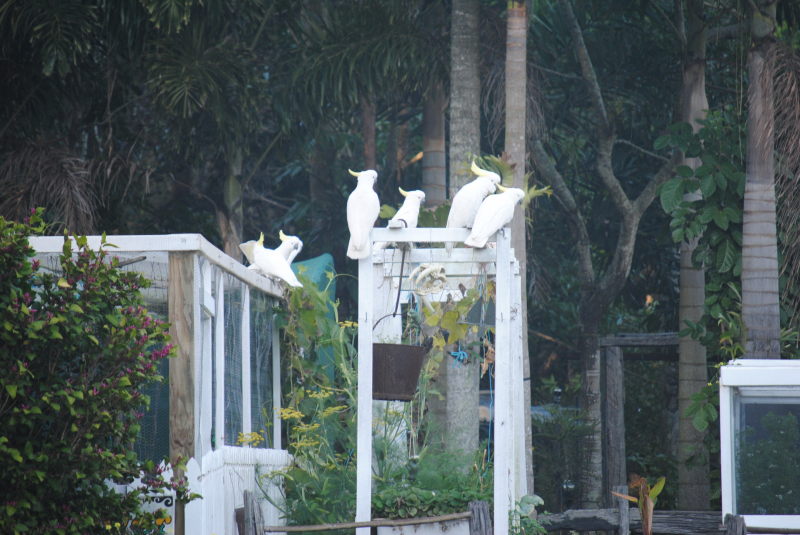
Another visit from our spectacu
 lar native bird called the Sulphur Crested Cockatoo this morning. This time they were initially hanging around the front of the house in a gum tree, and then they all flew around the back to my aquaponics area. They are such a lovely bird with a real raucous call. One of the photos even has a magpie in as well for good measure.
Also a photo of a young calf from our friend's farm at Boonah that we visited last week.
So far the crow is fine - sitting on a perch as large as life.
Subscribe to:
Posts (Atom)